Steel Structure vs
RCC Building in Bangladesh – Which is Better for Your Industrial Project?
Introduction
When planning a factory, warehouse, or industrial building
in Bangladesh, the very first and most critical decision you face is — should
you go with a Steel Structure or RCC (Reinforced Cement Concrete)?
The question sounds simple, but the wrong choice can cost
you millions of taka in wasted time, money, and quality on a major project.
Having worked on numerous industrial facilities, garment factories, cold
storages, and warehouses across Bangladesh over the years, we have seen
firsthand — the right structural choice is the very foundation of a
project's success.
In this article, we break down both methods in detail so you
can make the most informed decision for your specific project.
🔍 What is a Steel
Structure (PEB) Building?
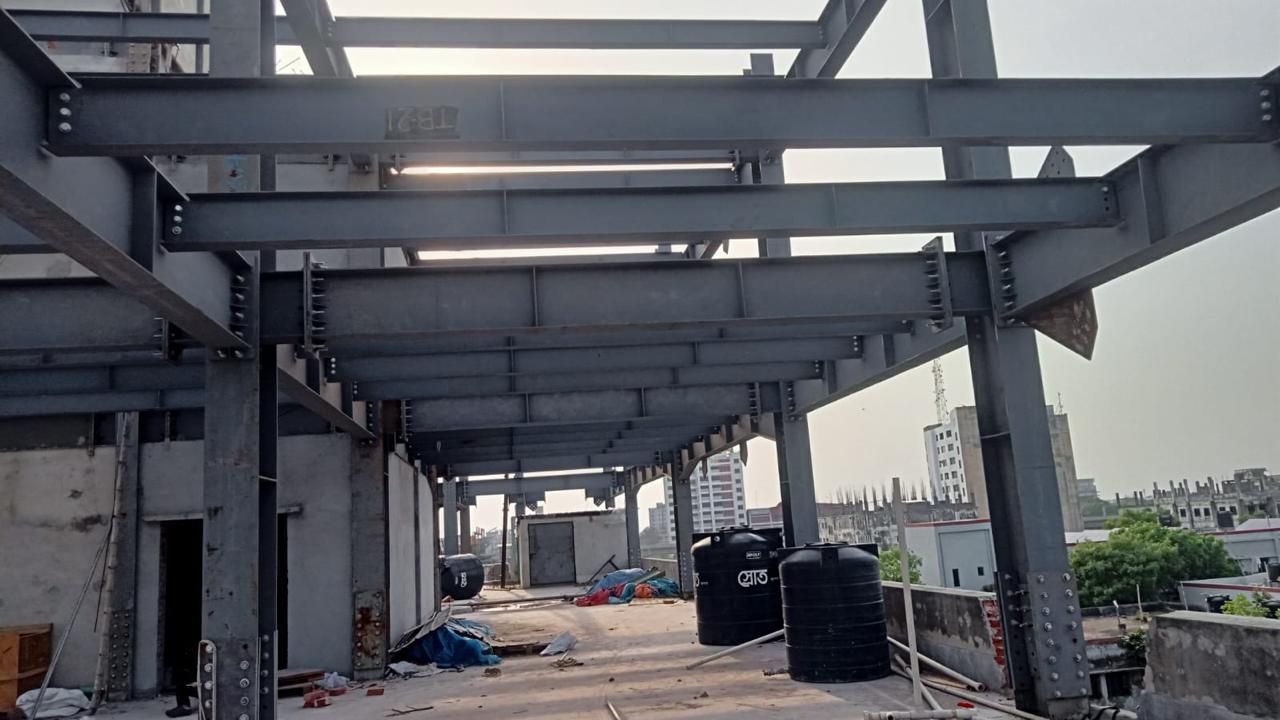
A Steel Structure or Pre-Engineered Building (PEB) is
a construction method where all structural components — columns, rafters,
purlins, girts — are precision-manufactured in a factory and then transported
to the site for bolt-together assembly.
It is primarily used for:
Key characteristic: Factory-made, quality-controlled,
fast to erect, and involves almost zero wet work on site.
🧱 What is an RCC
Building?
RCC or Reinforced Cement Concrete is the traditional
construction method where cement, sand, aggregate, and steel reinforcement bars
are used to cast the structure directly on site.
It is commonly used for:
Key characteristic: Site-cast, durable, but
time-consuming and expensive for large-span industrial use.
⚖️ Steel Structure vs RCC – A
Detailed Comparison
1. Construction Time
This is arguably the single biggest difference between the
two methods.
A 50,000 sqft warehouse built using RCC typically
takes 12 to 18 months to complete. The same building in Steel Structure
can be finished in as little as 3 to 5 months.
The reason is straightforward — in RCC, every column, beam,
and slab must be cast and cured on site, which takes time. In Steel Structure,
once the foundation is ready, the entire frame goes up rapidly.
Real-world example: Many factory owners in Gazipur
and Savar have told us that by choosing Steel Structure, they were able to
begin production 6 to 8 months earlier than they originally planned — which
directly improved their return on investment.
2. Cost Analysis
This is where many people make a mistake. Steel may look
expensive at first glance, but when you consider the total project cost,
Steel Structure is often the more economical choice.
Here is why:
That said, for multi-storey or vertical buildings,
RCC can still be the more cost-effective option.
3. Design Flexibility and Future Expansion
This is something many clients do not think about at the
start — but almost always wish they had.
Steel Structure buildings are extremely easy to expand in
the future. You can simply open one end wall and add new bays without any
structural damage to the existing building. In RCC, doing the same thing is
practically impossible without demolishing major portions of the structure.
In Bangladesh's industrial context, this matters enormously,
because most factory owners want to expand their capacity within 2 to 3 years
of initial construction.
4. Weight and Foundation
The dead load of a Steel Structure is approximately 30 to
40% less than that of an equivalent RCC building. As a result:
5. Durability and Maintenance
One genuine advantage of RCC is that when properly built, it
is extremely durable and generally requires little maintenance over its
lifetime.
Steel Structure, on the other hand, requires regular anti-corrosion
treatment and painting maintenance, especially in Bangladesh's hot and
humid climate. However, with modern hot-dip galvanization and high-quality
epoxy coating systems, corrosion can be effectively managed and kept well under
control.
6. Seismic and Wind Performance
Bangladesh sits in a seismically active zone, and cyclone
risk from the Bay of Bengal is a real concern for industrial buildings. In this
regard, Steel Structure has a significant advantage — it is highly ductile.
This means that under seismic loading, it bends and deforms before collapsing,
giving warning signs before failure. RCC is brittle by nature, which means it
can fail suddenly without much warning.
A properly designed Steel Building can also be made fully
cyclone-resistant, which is particularly important for industrial facilities in
the coastal and southern regions of Bangladesh.
📊 Quick Comparison Table
|
Factor |
Steel Structure (PEB) |
RCC Building |
|
Construction Time |
3–5 months |
12–18 months |
|
Large Clear Span |
✅ Ideal |
❌ Expensive |
|
Foundation Cost |
Low |
High |
|
Future Expansion |
Very easy |
Very difficult |
|
Seismic Performance |
Excellent (ductile) |
Risk of sudden failure |
|
Maintenance |
Regular painting needed |
Comparatively low |
|
Multi-storey Use |
Limited |
Ideal |
|
Humid Climate |
Needs corrosion protection |
Performs well |
🏭 Why Steel Structure Has
Become the First Choice for Industry in Bangladesh
Bangladesh's garment, textile, pharmaceutical, and logistics
sectors have expanded at a remarkable pace over the past decade. The demands of
this market are clear:
✅ Fast construction —
because production timelines cannot wait.
✅ Large column-free floor
space — intermediate columns disrupt production line layouts.
✅ Room for future expansion
— as business grows, the building must be able to grow with it. ✅
Suitability for flood-prone areas — lighter structures mean less
foundation load on soft ground.
This is precisely why demand for PEB Steel Structures
continues to rise across industrial zones in Gazipur, Savar, Narayanganj,
Chittagong, Comilla EPZ, and throughout the country.
When Should You Choose RCC Instead?
Steel is not always the right answer. RCC may be the better
choice in the following situations:
✅ Conclusion
If your project is a factory, warehouse, industrial shed,
or logistics facility — the answer is clear. Steel Structure (PEB) is
the best choice for industrial construction in Bangladesh today.
Shorter construction time, lower foundation cost,
column-free large spans, and easy future expansion — these four factors alone
make a compelling case.
However, it is important to remember that even the best
structural system can fail without proper design, quality materials, and an
experienced contractor. Before finalizing your decision, always consult a
qualified structural engineer or PEB specialist who understands the local soil
conditions, building codes, and climate requirements of Bangladesh.
📞 Need Expert Help?
Zahid Steel Ltd. has been delivering complete Steel
Structure and PEB solutions for industrial facilities and warehouses across
Bangladesh — from initial design through to final construction handover.
👉 Contact us today
for a free consultation and quotation.